
A Mindful Home Is Not Just Aesthetics: It’s Making It Yours
A good looking home can still feel wrong. A mindful home begins when a space supports how you live, not just how it photographs.
The idea of a mindful home often gets flattened into style. Clean lines, neutral palettes, and a sense that everything matches have become shorthand for mindfulness because they are easy to recognize and easy to share. That version may look composed, but it is incomplete. A mindful home is not defined by how it appears at first glance, but rather it is defined by how it works over time, how it supports your energy, how it holds your habits, and how it feels on an ordinary Tuesday evening rather than a moment prepared for company.
A space can be aesthetically pleasing and still ask too much of you. It may demand constant attention, require ongoing adjustment, or quietly expect you to adapt yourself to it. Mindfulness in the home has less to do with visual harmony and more to do with alignment between the space and the person living inside it.
This distinction matters, especially for people interested in personal development. Your environment is not neutral. It either supports your growth or quietly resists it, shaping your days through small, repeated signals.
Why aesthetics became the default goal
Design culture made aesthetics the entry point because aesthetics travel well. A photo can communicate color, composition, and texture instantly, but it cannot show whether a room reduces stress, supports focus, or makes daily routines feel smoother.
As a result, many homes are designed outward first. What will this say about me? How will this look to others? What belongs on this wall according to the style I chose? These questions are not wrong, but they are incomplete on their own.
When aesthetics lead without context, they tend to override function. This shows up as furniture that looks right but is rarely used, rooms that feel staged rather than lived in, or homes that perform visually but do little to support the people inside them. A mindful home asks for a different starting point, one rooted in experience rather than appearance.
A mindful home is designed around friction
One practical way to think about a mindful home is through friction. Where does your space make things harder than they need to be?
Friction usually appears quietly. You may avoid a room because it feels awkward, never sit in a chair that technically fits the layout, feel restless in a space meant for rest, or struggle to focus where you are supposed to work. These moments are easy to dismiss, but they are not personal failures. They are signals of design mismatch. Research on interior environments supports this idea, showing that spatial design influences stress, comfort, and daily psychological functioning in measurable ways.
A mindful home reduces unnecessary friction. It supports movement, rest, attention, and transition without asking you to constantly adapt yourself to the space. That is why layout, lighting, sound, and visual density matter so much. They are not purely aesthetic choices, even though they shape how a room looks.
Personalization is not decoration
Personalization is often treated as surface level. Add a few objects that feel personal and move on. In reality, personalization is structural. It is about shaping the space around your actual life rather than an idealized version of it.
This begins with honest observation. How you start your mornings, where you naturally pause during the day, what you avoid doing at home and why, and which activities restore you versus drain you all offer meaningful information. Design decisions tend to work better when they respond to what is already happening in a room rather than trying to impose an idea onto it, an approach we explore further when thinking about wall art in living rooms. A mindful home reflects these realities instead of trying to correct them.
For people focused on personal development, this is not a minor detail. Your environment reinforces behavior. When your space makes it easier to do what you value, growth becomes more sustainable. Personalization, in this sense, is less about expressing identity and more about supporting behavior.
When beautiful spaces fail the body
One of the most overlooked aspects of a mindful home is the body.
A room can be visually composed and still feel uncomfortable to inhabit. Chairs can encourage tension, tables can force awkward posture, and lighting can strain the eyes by evening. Mindfulness includes physical awareness, and if your body never fully settles in your own home, something is off. This kind of discomfort is easy to normalize in daily life, and it often looks like small, familiar moments.
Addressing this does not require expensive changes. It requires attention. Noticing whether a seat invites staying or signals short visits, whether a room supports stillness or constant movement, and whether the scale of objects feels grounding or overwhelming can reveal more than any mood board. A mindful home respects the body as much as the eye.
Walls shape attention more than we admit
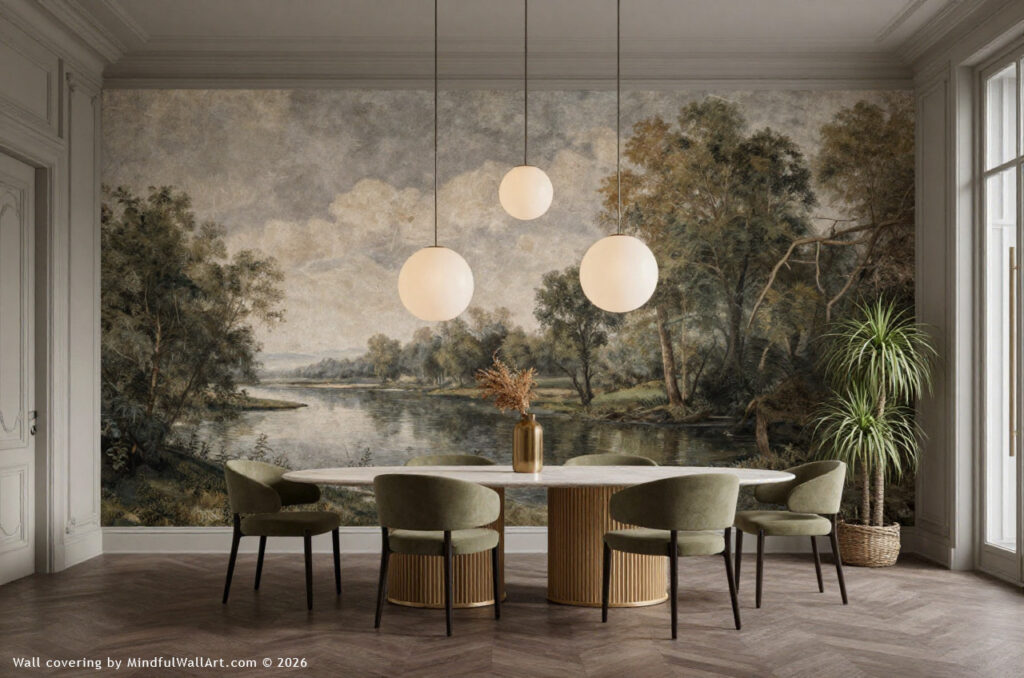
Walls are not passive. They are the largest visual surfaces in most homes, and they strongly influence how attention moves through a space.
Blank walls can feel calm or empty depending on context, just as busy walls can feel engaging or exhausting. The difference is intention. A mindful home considers how long the eye rests on a wall and what that resting does to the mind.
Some walls should hold attention, while others should allow it to drift. Not every surface needs to speak. When walls are treated only as aesthetic opportunities, they often become overworked. When they are treated as part of the mental landscape of the home, decisions become clearer and calmer.
A mindful home supports different modes of living
One reason purely aesthetic homes often struggle is that they assume a single mode of use. Everything looks good, but nothing adapts.
Real life moves through different modes, including focus, rest, connection, solitude, and transition. A mindful home acknowledges this and allows different areas to support different states without conflict.
This does not require labeling rooms or enforcing rigid rules. It simply means allowing visual and spatial cues to do quiet work. A corner that signals pause, a table that invites gathering, or a wall that steadies attention can gently guide how a space is used. When a home supports these shifts, daily life feels less effortful.
Growth oriented people need honest spaces
People interested in personal development often underestimate how strongly their environment influences progress.
A home that constantly demands attention leaves less capacity for reflection. A space that feels performative can create subtle pressure to maintain an image. A mindful home allows honesty. It allows rest without guilt, focus without tension, and presence without effort.
This does not require minimalism or any specific look. It requires coherence between values and environment. If growth matters to you, your home should not work against you.
How to use this at home
Choose one room and observe it for a week without planning changes. Pay attention to where you naturally sit, what you tend to avoid, when the room feels supportive, and when it feels draining.
After that, make one adjustment that reduces friction. This might mean moving or removing something, changing the lighting, simplifying a wall, or adding a single element that supports how you want to feel in the space. A mindful home is built through small, thoughtful decisions rather than sweeping overhauls.
A mindful home is not a style. It is a relationship between a person and a space. Aesthetics matter, but they are not the goal. The goal is a home that supports your body, your attention, your habits, and your growth, creating alignment rather than pressure.
When your home works with you instead of asking you to perform, it becomes more than a backdrop. It becomes a steady infrastructure for a better daily life.